Capitol Hill
Lock work on Capitol Hill row houses
Much of the Hill sits inside a historic district, and a lot of the hardware on it is older than the people who own it. That changes the first question from what to replace to what is worth keeping.
Hardware that predates the modern deadbolt
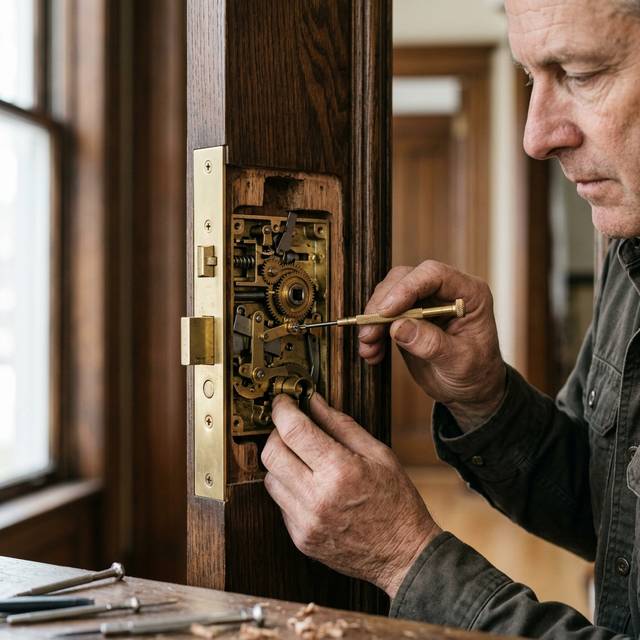
Row houses around Lincoln Park, Eastern Market and the streets off Pennsylvania Avenue commonly still carry their original mortise locks: a rectangular case buried in the edge of the door, running both the handle and a bolt, with a keyhole that takes a bit key rather than a cylinder. Many were later fitted with a separate deadbolt higher up, and the two have never shared a key.
Old mortise cases were built to be opened and serviced. Springs, followers and levers can be replaced, and a cylinder can usually be rekeyed without the lock leaving the door. Where the case itself has cracked, a replacement has to fit an existing pocket, which is where the measurements start to matter: backset, case depth, handle and keyhole spacing. A photo of the door edge with a tape measure against it answers most of this before a visit.
Doors that move with the weather
A century-old door in a brick opening is a seasonal object. It swells through a humid July and shrinks back by November, and the hardware fitted to it has to cope with several millimeters of movement a year. That is why so many Hill doors are fine for eight months and then need a shove.
The fix is nearly always at the strike rather than the lock: enlarging or moving the pocket, adjusting the plate, or dealing with a hinge that has lost its grip in old timber. Replacing a working lock because the door has swollen is a common and expensive mistake. The troubleshooting guide walks through how to tell the two apart from your side of the door.
Historic district considerations
A large part of Capitol Hill falls within a designated historic district, and exterior alterations visible from the street can require review. In practice, rekeying a cylinder or servicing an existing lock raises no issue at all. Changing the visible face of the hardware — a new escutcheon, a different finish, a modern deadbolt where none existed — is worth checking with the Historic Preservation Office before anything is bought.
It is also a reason to be careful with hardware you cannot put back. Original knobs, plates and box locks are worth keeping even when they no longer operate, and we take them off intact rather than through them.
Basement flats and rented floors
Hill houses are full of English basements rented separately, and upper floors divided into flats. That produces the same question every time: which key opens what, and does the connecting door genuinely lock. It is a keying problem rather than a hardware problem, and a rekey across the house usually solves it without anything new going on a door.
Working on the Hill
Streets here are narrow, parked solid, and often on residential permit zones with two-hour limits. Loading is easier before 9 AM than at midday. Barracks Row and the blocks around Eastern Market add commercial work to the mix — restaurants, shops and offices with storefront doors that cycle constantly and need hardware built for it.
Questions and answers
Questions about Capitol Hill work
Can my original mortise lock be kept and still be secure?
Often, yes, though it depends what it is doing. A serviced mortise case with a sound bolt is a real lock. A worn bit-key lock on its own is not much of one, which is why most Hill houses have a separate deadbolt as well. Keeping the original on the door and relying on the deadbolt for security is a common and sensible arrangement.
My front door sticks every summer. Should I replace the lock?
Almost certainly not. If it works in winter, the lock is fine and the door has moved. Adjusting the strike, easing the edge or dealing with a dropped hinge addresses the actual cause. A new lock fitted into the same misaligned opening behaves exactly the same way.
Do historic district rules stop me fitting a deadbolt?
They are not a blanket prohibition, but exterior changes visible from the street can require review, and rules vary by property. Check with the Historic Preservation Office before ordering hardware. Rekeying and servicing what is already there does not raise the question.
Can you match a new lock to the original key on an old door?
Sometimes. Bit-key mortise locks and modern cylinders are different systems, so a single key across both is unlikely. What is normally achievable is getting every cylinder lock in the house — deadbolt, back door, basement — onto one key, leaving the original as it is.
Is parking a problem for a visit?
It can be. If you have a permit space, an alley spot or a stretch of unrestricted curb nearby, mentioning it when you book genuinely helps. Early morning is easier than the middle of the day on most Hill streets.
Keep reading
Reading for an older house
Historic doors bring up the same three topics more than anything else.
An old door is not automatically a problem
Send a photo of the hardware and the door edge, and we can usually tell you what you have before a visit.