Guide
Rekeying or replacing a lock: how to decide
People usually arrive at this question having already decided the answer is expensive. It generally is not, because the two options solve different problems and most situations only call for the less expensive one.
They answer different questions
Rekeying changes which key a cylinder accepts. The lock stays on the door, and every key cut to the old pattern stops working. Replacement takes the hardware off and puts different hardware on.
So the first thing to work out is which question you are actually asking:
- “Somebody has a key I would rather they did not.” That is a rekeying question.
- “This lock is not doing its job.” That is a replacement question.
They get confused because both are described as “changing the locks” in everyday speech. Real estate agents say it, insurers say it, and it usually means the first thing while sounding like the second.
Side by side
| Rekeying | Replacement | |
|---|---|---|
| What changes | The pins inside the cylinder | The whole lock |
| Old keys | Stop working | Stop working |
| Appearance of the door | Unchanged | Changes, and old fixing holes may show |
| Time per door | Minutes | Longer, and depends on fit |
| Relative cost | Lower — labor and a few pins | Higher — labor plus hardware |
| Improves resistance to force | No | Only if you buy something better |
| Can put several doors on one key | Yes | Yes, but at hardware cost |
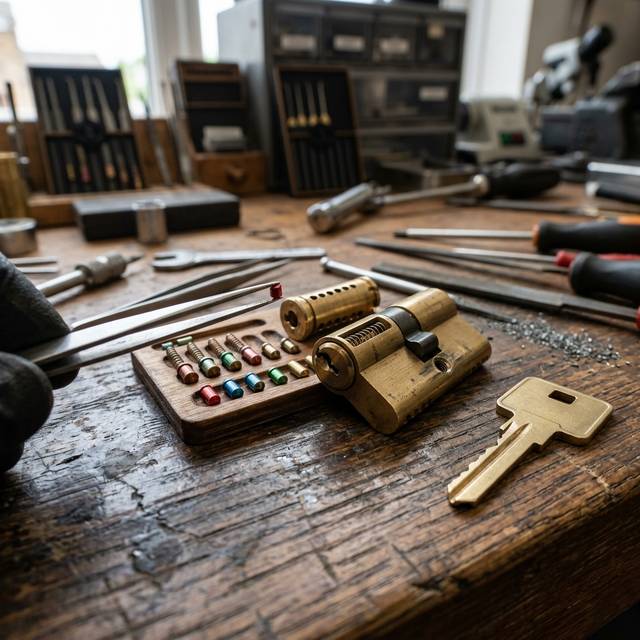
When rekeying is enough
In most cases where the hardware works. Specifically:
- You have just bought or rented the property and do not know the key history.
- A key has been lost outside the house, particularly on a ring with an address or a parking tag.
- A lease or a house share has ended.
- Building work has finished and contractors held keys.
- A relationship has ended and someone has a key you would rather they did not.
- You are carrying several keys for one house and want one.
The full mechanism, and what happens to any spares you still need, is on the rekeying page.
When only replacement will do
- The lock is worn or damaged. Binding with a fresh key, a bolt that does not throw fully, a cracked case. Repinning a failing lock buys nothing.
- It has been forced. Anything that has taken an attack should come off, even if it still turns.
- There is no deadbolt. Rekeying cannot add security that was never there.
- You want different hardware. A keypad, a connected deadbolt or a restricted keyway all mean new locks by definition.
- Parts are gone. Some 1960s and 1970s hardware has no spares left in the world.
The middle option people forget
You can replace one cylinder and rekey the rest. If five doors have compatible keyways and one does not, swapping that single cylinder and pinning everything to one key costs far less than five new locks — and the door still looks the same.
Two questions that decide it in practice
Does the lock work properly today?
Not “does it open” but does it operate smoothly with a good key, throw fully, and hold the door without play. If yes, you almost certainly want a rekey. If no, work out why before buying anything — a door that has dropped will make new hardware behave exactly like the old hardware. The latching checks separate the two.
Are you trying to keep somebody out, or something out?
Keys in the wrong hands is a rekeying problem. Someone putting a shoulder to the door is a hardware and frame problem, and the answer there is a better bolt with a reinforced strike rather than a different key.
What insurers and landlords tend to ask for
Requirements vary and are worth reading rather than assuming. In general, a policy or a lease that says locks must be “changed” between occupants is satisfied by rekeying, because the test is whether previous keys still work. Where a specific standard or grade of lock is named, that is a hardware requirement and rekeying will not meet it. If you are a tenant, ask the landlord before arranging either.
Questions and answers
Follow-up questions
Does rekeying always cost less than replacing?
Per door, nearly always, because you are paying for labor and a handful of pins rather than labor and hardware. The exception is a lock that cannot be rekeyed at all, where the attempt is wasted effort.
Can a lock be rekeyed more than once?
Yes. There is no practical limit on a sound cylinder. Locks in rental properties get rekeyed every few years for decades without complaint.
Does rekeying leave any trace on the door?
None. The lock does not come off the door in most cases, and nothing about its appearance changes. This is one reason it suits historic hardware, where replacement leaves marks that are hard to undo.
Keep reading
Where to go from here
Whichever way the decision falls, these pages cover what happens next.
Not sure which side your situation falls on?
Describe the lock and what prompted the question. It is usually a short conversation.